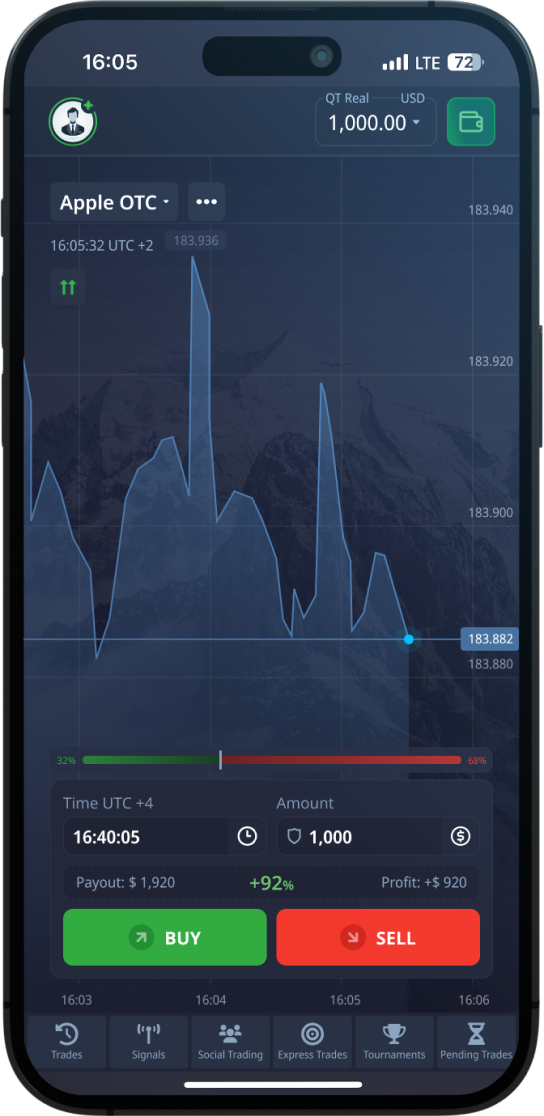
Register in a couple of minutes, switch to a free demo to practice without risking real money, and verify your identity when you're ready to trade live. Here's exactly how each step works.

Creating an account in the Pocket Option app is quick — you can sign up with an email address and password or use a Google or Facebook login. Once registered, you land on a free demo account preloaded with virtual funds, so you can explore the interface, test strategies, and place practice trades before committing any of your own money.
Verification becomes relevant when you want to deposit, withdraw, or trade with real funds. The process asks for basic identity and address documents and usually takes a short while to review. Trading involves real financial risk and you can lose the money you put in, so take your time on the demo first and only fund an account you've verified and fully understand.
Creating an account on the Pocket Option mobile app takes only a few minutes from your phone.
Install the Pocket Option app from the App Store or Google Play, then open it and tap the sign-up option on the welcome screen. You can also register through the mobile browser version if you prefer not to install anything.
Provide a valid email address and choose a strong password with letters, numbers, and a symbol. Alternatively, you can register instantly using a Google, Facebook, or Apple account, which links your login to that provider.
Select the base currency for your balance, such as USD or EUR. This currency applies to deposits, trades, and withdrawals, so choose the one that matches how you fund the account to avoid conversion costs.
Open the confirmation message sent to your inbox and tap the verification link. Until you confirm, some features stay limited, so do this before your first deposit.
A demo balance loads automatically so you can explore the platform risk-free. When you feel ready, switch to the real account and make a deposit to start trading with your own money.
Both account modes share the same interface and tools, but they serve different purposes.
Loads with virtual funds you can top up at any time. Use it to learn the controls, test strategies, and understand how trades settle without risking real money. Nothing you win or lose here is withdrawable.
Funded with your own deposit. Trades use live market conditions, profits are real and withdrawable, and losses reduce your balance. Switch to it only once you are comfortable with how the platform behaves.
One tap on the balance area toggles between demo and real modes. You keep both available, so you can return to the demo to test a new idea even after you start trading for real.
The real account unlocks deposit bonuses, cashback, and prize tournaments. Read each promotion's terms first, because bonuses usually carry trading-volume conditions before associated funds can be withdrawn.
Verification, often called KYC (Know Your Customer), is the process of confirming that you are a real person and that the account belongs to you. Pocket Option asks for it to comply with anti-money-laundering rules and to protect your funds from unauthorized access. You can register and trade on a demo without verifying, but completing KYC is what unlocks smooth, higher-limit withdrawals.
The process is handled entirely inside the app. You upload a photo of a government-issued ID, sometimes a proof-of-address document, and occasionally a picture of the payment method used for deposits. Image quality matters: make sure all four corners are visible, the text is sharp, and there is no glare. Blurry or cropped documents are the most common reason a submission gets sent back.
Review times vary. Many users are approved within a day, while busier periods can take longer. You will receive a notification when your documents are accepted or if something needs to be resubmitted. It is worth completing verification early, before you plan to withdraw, so there is no delay when you actually want your money out.
A quick reference for what you commit to when you open and fund an account.
| Parameter | Detail |
|---|---|
| Registration time | Around 1-2 minutes by email or social login |
| Minimum age | 18 years or older, depending on your jurisdiction |
| Demo balance | Virtual funds, refillable, no deposit needed |
| Account currency | Set at sign-up; applies to deposits and withdrawals |
| Email confirmation | Required to unlock full functionality |
| KYC verification | Needed for reliable, higher-limit withdrawals |
| Login options | Email and password, or Google, Apple, or Facebook |
Once your email is confirmed, the cashier section lets you fund the real account. The Pocket Option app supports a broad mix of payment methods, including bank cards, e-wallets, and various cryptocurrencies. The exact options you see depend on your region and the account currency you chose at sign-up, so the menu is tailored to you rather than identical for every user.
Deposits are usually credited quickly, often within minutes for cards and crypto. There is a low minimum deposit, which makes it easy to start small and scale up only when you are confident. Always note any method-specific minimums and whether a deposit qualifies for a bonus before you confirm the transaction.
Withdrawals follow the same channel logic but include a security step: in most cases you withdraw back to the method you deposited with. This is standard practice across regulated-style platforms and helps prevent fraud. Processing has two parts: the platform's internal review, plus the time your bank or wallet provider needs to settle the funds on their end.
To keep withdrawals smooth, finish KYC verification first, keep your payment details consistent, and be aware that very large or first-time withdrawals may trigger an extra check. None of this guarantees a profit; trading carries real risk of loss, and you should only fund an account with money you can afford to lose.
Your trading account holds money and personal data, so treating its security seriously is part of responsible use. The single most effective habit is enabling two-factor authentication (2FA) in the app's settings. With 2FA on, logging in requires both your password and a one-time code, which stops anyone who only has your password from getting in.
Use a password you do not reuse anywhere else, and avoid logging in over public Wi-Fi without a trusted connection. If you signed up through Google, Apple, or Facebook, the security of that linked account directly affects your trading account, so keep that provider protected as well.
Be alert to phishing. Pocket Option will not ask for your password by email or message, and you should only ever enter credentials inside the official app or on the official site. Bookmark the real address, ignore unsolicited links promising bonuses, and double-check the sender before acting on any urgent-sounding request.
Finally, keep the app updated. Updates often include security patches alongside new features. If you suspect your account has been accessed by someone else, change your password immediately and contact support through the in-app channel rather than any link you received from an outside source.
Yes. Registering an account and using the demo with virtual funds costs nothing. You only commit money when you choose to make a deposit into the real account to start live trading.
No, you can register and trade right away, including on the demo. However, completing KYC verification is strongly recommended because it is what enables smooth, higher-limit withdrawals when you want to take your funds out.
Yes. Both modes live under the same login. You toggle between the virtual demo balance and your real funded balance with a single tap, so you can keep testing strategies on the demo even after going live.
Pocket Option uses a low minimum deposit, so you can start small. The exact figure depends on your chosen payment method and currency, which you can confirm in the cashier section before funding your account.
Many users are approved within about a day, though busier periods can take longer. You will get a notification once your documents are accepted or if anything needs to be resubmitted, so verify early rather than waiting until you want to withdraw.
The account currency is set during sign-up and generally cannot be changed afterward. If you need a different base currency, the usual path is to contact support, who can advise on the available options for your situation.
From the sign-up form to your first trade, the full registration flow takes only a few minutes on web or mobile.
Tap Register and decide whether to use an email and password or a one-click social login through Google or Facebook. Email gives you the most control over recovery and notifications, so it is the option most traders prefer.
Provide your email, create a strong password, and pick your base account currency. The currency you select here applies to balances, deposits, and payouts, so choose the one you will fund with most often.
Open the confirmation message Pocket Option sends and click the activation link. This unlocks deposits, withdrawals, and bonus eligibility, and it ties recovery to an inbox only you can access.
Every new account starts with a funded practice balance. Place a few trades to learn order entry, expiry times, and the chart tools before any real money is involved.
Switch to the real balance, add funds with a supported payment method, and you can begin live trading. Verification can be completed before or shortly after your first deposit.
Both balances live inside the same login, so you can switch between practice and live trading whenever you want.
The demo runs on virtual funds, so mistakes cost nothing. It is the right place to test a strategy, learn the platform, and build a routine before committing capital.
If your practice balance runs low, you can top it back up to a fresh starting amount. That makes it easy to retest an idea from a clean slate as many times as you like.
The real balance uses your deposited funds and produces withdrawable profits or genuine losses. Emotions behave differently with money on the line, which is exactly what live trading teaches.
A balance selector at the top of the trading screen flips between demo and real. There is no need to log out or open a separate account to move between them.
KYC is straightforward when you have the right documents ready. Here is what each stage usually asks for.
| Step | What you submit | Purpose |
|---|---|---|
| Email confirmation | Click the activation link | Activates the account and secures recovery |
| Identity proof | Passport, national ID, or driver's licence | Confirms you are a real, eligible adult |
| Address proof | Utility bill or bank statement, usually under 3 months old | Validates your residence for compliance |
| Payment proof | Card photo with middle digits hidden, or e-wallet screenshot | Links the funding method to your name |
| Selfie check | Photo of you, sometimes holding your ID | Prevents impersonation and account takeover |
The payment options shown during and after registration depend on the currency and region linked to your account, so it is worth thinking about how you plan to fund before you finish signing up. Most traders see a mix of bank cards, e-wallets, and cryptocurrencies, each with its own speed, fees, and limits.
Cards are familiar and widely accepted, but they are also the most likely to require document proof during withdrawals because compliance rules tie a card to a verified name. E-wallets tend to clear faster and add a layer of separation between your bank and the trading platform, which many users prefer for convenience.
Cryptocurrency deposits appeal to traders who want quick settlement and fewer intermediaries, though the value you receive can move with the market between sending and crediting. Whichever route you choose, using the same method for deposits and withdrawals usually keeps the process smoother and faster.
A practical habit is to fund with the method you can also withdraw to, and to keep the name on that method matching your account exactly. Mismatched names are the single most common reason a payout gets delayed for extra checks.
Beyond the demo and real balances, your standing on Pocket Option can change over time based on trading activity and total deposits. New accounts start at a base level, and consistent volume can unlock higher status tiers that come with added perks.
Higher tiers commonly bring benefits such as priority withdrawal processing, access to a personal manager, occasional cashback, and invitations to platform tournaments. These are progression rewards rather than something you select at registration, so there is no premium plan to buy when you sign up.
It is important to keep expectations realistic: status levels improve the experience and convenience around your account, but they do not change the underlying risk of trading. A higher tier does not make outcomes more predictable, and no level removes the possibility of losing the money you put in.
If account perks matter to you, the most sustainable path is steady, disciplined activity rather than oversized deposits chasing a tier. Trade within a budget you can afford to lose, and let any status benefits arrive as a side effect of consistency.
Most sign-up issues come from small, fixable details rather than anything wrong with the platform. The confirmation email is the usual culprit: if it does not appear within a few minutes, check spam and promotions folders before requesting a resend, and make sure you typed your address correctly.
Another frequent snag is using inconsistent personal information. The name, date of birth, and country you enter at registration should match the documents you will later submit for verification, because mismatches force a manual review that slows everything down.
Duplicate accounts cause problems too. Registering more than once with the same identity can trigger automatic restrictions, so if you already started an account, recover that login instead of creating a new one. Keeping a single, fully verified account is always the cleanest approach.
Finally, set up your security early rather than later. Enabling two-factor authentication and saving your recovery email during the first session means a forgotten password or a new device never locks you out of funds you have deposited.
Yes. You can complete the entire sign-up on the Pocket Option mobile app or the mobile browser, including email confirmation, demo practice, and uploading verification documents using your phone's camera. The flow mirrors the desktop version step for step.
No. The practice balance is available immediately after you create an account, with no documents required. Verification only becomes relevant once you start funding and withdrawing from the real balance.
First check your spam and promotions folders, since automated messages often land there. If it is still missing, confirm you entered the correct address and use the resend option. Adding the sender to your contacts helps future messages arrive in the main inbox.
In most cases payouts must return to the same method you funded with, especially for card deposits, because of compliance rules. Using one consistent method for both deposits and withdrawals is the most reliable way to avoid delays.
No. Creating an account is free and carries no obligation to deposit. You can stay on the demo balance indefinitely, and you only add funds if and when you decide to trade live.
You can access the same account from your phone, tablet, and computer, and your balances and trade history stay synced across them. For safety, enable two-factor authentication so a new or unfamiliar device cannot be used without your approval.
From download to your first login, the whole process usually takes under five minutes on a phone.
Get the Pocket Option app from the App Store or Google Play, or use the APK linked on the official site for devices without Play Store access. Avoid third-party mirrors that repackage the app.
Open the app and pick how you want to register: an email and password, or a one-tap social login through Google, Facebook, or another supported provider. Social login skips the email-confirmation step.
Type a valid email, set a strong password, and select your base account currency. Pick the currency you actually plan to fund with, since it is fixed once the account is created.
Tick the box to accept the user agreement and risk disclosure, then submit. With email sign-up, tap the confirmation link sent to your inbox before your first trade.
Sign in with your new credentials. You land on the demo account by default, pre-loaded with virtual funds, so you can test the interface before depositing anything real.
Both run inside the same app on the same charts. The difference is whether the money and results are real.
The demo is funded with virtual currency you can reset if it runs low. Mistakes cost nothing, making it the right place to learn order types and platform mechanics.
Assets, indicators, payouts, and expiry times mirror the live environment closely, so what you practice on the demo translates directly to a real account.
A real account uses money you deposit. Profits are yours to withdraw, and losses are real, which is why position sizing and discipline matter from the first trade.
A single toggle in the app moves you between demo and real balances. There is no separate registration, and your settings and watchlists carry across both.
KYC is staged. You only complete a step when a deposit, withdrawal, or limit makes it necessary.
| Stage | Document or detail | When it is requested |
|---|---|---|
| Email confirmation | Valid email address | At sign-up, before your first real trade |
| Profile details | Full name, date of birth, country | When you open a real account or first deposit |
| Identity (ID) | Passport, national ID, or driver's licence | Before larger withdrawals or on request |
| Address | Utility bill or bank statement under 3 months old | When confirming residency for withdrawals |
| Payment method | Card photo with middle digits hidden, or e-wallet proof | To confirm ownership of the funding source |
The credentials you set during registration are the keys to real money once you fund the account, so it is worth getting them right on the first try. Use an email address you control long-term and check regularly, because password resets, withdrawal confirmations, and security alerts all flow through it. A throwaway or work address you might lose access to can lock you out of your own funds.
For the password, length matters more than complexity tricks. A passphrase of several unrelated words is both easier to remember and harder to crack than a short string of symbols. Never reuse a password you already use on another site; if that site is breached, attackers routinely try the same combination on trading platforms.
If your sign-up method offers two-factor authentication, enable it immediately rather than putting it off. A second factor means a leaked password alone is not enough for someone to reach your balance. The few seconds it adds to each login is a fair trade for protecting deposited funds.
Treat the recovery email as part of your security setup, not an afterthought, and keep it as protected as the trading account itself.
Registration gives you access to live pricing, and it pays to study how the platform quotes trades before committing money. On fixed-time trades, the payout percentage is the figure that decides your reward: a payout of 80 percent means a winning position returns your stake plus 80 percent, while a loss costs the full stake. Higher-payout assets are not automatically better, because payout often reflects how predictable an instrument is.
Payouts are not static. They shift with the asset, the time of day, market volatility, and how close you are to a major news release. The same currency pair can offer different payouts in the morning and evening, so check the current figure on the order screen rather than assuming yesterday's number still applies.
On other instruments the cost shows up as a spread or commission instead of a payout. Knowing which model applies to what you are trading prevents surprises when a position closes slightly worse than the screen suggested. The demo account is the cheapest place to learn these patterns.
Spend time watching how payouts move across a full trading session before risking a real balance, so the numbers feel familiar by the time real money is on the line.
Pocket Option lets you stay logged in across a phone, tablet, and browser at the same time, which is convenient but worth managing deliberately. Your balance, open positions, and history sync in real time, so a trade placed on your phone appears instantly on the desktop. That continuity is useful, but every active session is also a door into your account.
Be cautious about logging in on devices you do not fully control, such as a shared family tablet or a public computer. If you must, log out completely afterwards rather than only closing the app, and never tick any box that keeps you signed in on hardware that is not yours.
If you spot a session you do not recognise, change your password immediately, which forces a fresh login everywhere, and review your recent account activity. Combined with two-factor authentication, a prompt password change is the fastest way to shut out an intruder.
Periodically reviewing where you are signed in is a small habit that keeps a funded account firmly under your control.
Yes. The app supports one-tap registration through providers such as Google and Facebook. This skips the separate email-confirmation step, since the provider has already verified the address. You can still add a password later from your profile settings if you prefer logging in directly.
They do. There is no separate registration for the demo. Once you create an account you can toggle between the virtual demo balance and your real balance inside the same app, using the same credentials, watchlists, and settings.
You can reset the demo back to its starting virtual amount at any time from the account menu. It costs nothing and does not affect your real balance, so you can keep practising strategies without interruption.
No. Payouts vary by asset, time of day, market volatility, and proximity to news events. Always read the current payout on the order screen before placing a trade rather than relying on a figure you saw earlier.
Yes. You can enable two-factor authentication at any time from your account security settings, even if you registered without it. Turning it on is strongly recommended before you deposit real funds.
Yes. You must be of legal age in your jurisdiction, typically 18 or older, to open and operate a real account. The verification documents you submit during KYC confirm your date of birth, so the age you enter must match your official ID.
The core sign-up flow takes only a few taps once you have the app installed and an email address ready.
Download the Pocket Option app from your device's official store, open it, and tap the registration option on the welcome screen rather than the login option.
Type in a valid email address you can access immediately and set a password with at least eight characters mixing letters, numbers, and a symbol.
Choose the base currency for your balance. This affects how deposits and payouts are displayed, so select the one that matches the funds you plan to add.
Review the user agreement and risk notice, tick the box to confirm you are of legal age, and submit the form to create the account instantly.
Open the confirmation message sent to your inbox and tap the link inside. Until you confirm, some features such as withdrawals stay locked.
A practice balance lets you learn the interface and test ideas without putting real money at stake.
The demo loads with virtual funds you can refill, so a losing streak costs nothing and you can experiment with order sizes freely.
You get to know where charts, timeframes, asset lists, and order controls live before any of your own money is involved.
Run the same setup repeatedly on demo to see how it behaves across different assets and market conditions before scaling up.
Once you feel ready, toggling from demo to real happens inside the same app with no separate registration required.
Verification is tiered. You only complete the steps needed for what you actually want to do.
| Stage | What you submit | When it is required |
|---|---|---|
| Email confirmation | Click the link in the welcome email | Right after sign-up, before withdrawals |
| Identity (ID) | Passport, national ID, or driver's licence photo | Before your first withdrawal in most cases |
| Address proof | Recent utility bill or bank statement | If requested during a withdrawal review |
| Payment method | Screenshot or photo of the card or wallet used | When verifying the source of deposited funds |
A smoother sign-up starts with having a few things ready before you open the form. The single most important item is an email address you can check straight away, because the confirmation link arrives within seconds and the account stays partly limited until you click it.
It also helps to decide in advance which currency you want your balance held in. The app shows your deposits, payouts, and withdrawals in this currency, and while support can sometimes adjust it later, picking the right one now saves you conversion headaches down the line.
If you intend to fund a real account soon after registering, keep your chosen payment method on hand. Having the card, e-wallet, or crypto wallet details nearby means you can move from a fresh account to a funded one in the same session instead of stopping halfway.
The checkbox you tick during registration is not a formality. It confirms you have read the user agreement and the risk disclosure, and both contain details that affect how you should approach trading on the platform.
Trading carries real risk, and it is honest to say that you can lose the money you deposit. The platform does not promise profit, and any tool or signal you encounter is information rather than a guarantee. Reading the risk notice before you accept it sets the right expectations from day one.
The terms also cover practical points worth knowing early: how withdrawals are processed, what behaviour can lead to an account being restricted, and the conditions attached to any bonus you might accept. Skimming these now prevents surprises later.
Take particular care with bonus terms. Promotional credits often carry trading-volume conditions that affect when and how you can withdraw, so understand them before opting in rather than after.
Creating the account is only the first step. Once you are inside, a short pass through your settings makes the account safer and easier to use before you place a single order.
Start with your profile and security area. Confirm your email shows as verified, set a profile name if prompted, and enable any extra login protection the app offers so a stranger cannot reach your funds with just your password.
Next, glance at your notification and session preferences. Deciding which alerts you receive keeps the app useful without being noisy, and reviewing active sessions lets you sign out of any device you no longer use.
Finally, locate the help and support entry points while everything is calm. Knowing where live chat and the FAQ sit means that if a deposit or verification question comes up later, you already know where to turn.
The confirmation message usually arrives within a minute. If it does not, check your spam folder, make sure you typed the address correctly, and use the resend option in the app. The account exists in the meantime, but stays limited until you confirm.
You choose a base currency as part of registration because every balance figure is shown in it. You cannot really skip the choice, so decide in advance. Changing it afterward may be possible through support but is easier to get right the first time.
The information requested is the same in both places: an email, a password, a currency, and your agreement to the terms. Whichever you start on, the resulting account works across the app and the web with one login.
Most users are asked to confirm their email and complete identity verification by submitting a clear photo of an official ID before a first withdrawal. You may also be asked for proof of address or the payment method used, depending on the review.
Your email is your main login, so it cannot be changed casually from the form. If you need to switch it, contact support and they can guide you through the process, which may include re-verifying the new address.
It can. Promotional bonuses typically come with trading-volume conditions that must be met before bonus-related funds can be withdrawn. Read the bonus terms before accepting one so you understand the impact on your withdrawals.
Sign up in the app, practice on the demo with virtual funds, and verify whenever you decide to go live. No pressure — explore at your own pace.
Open My Account